9th Class GPA 4.0 Grading 2026 — What Actually Applies
If you are looking for a GPA 4.0 chart for your 9th class result, there is one thing you need to know before anything else: the GPA component has not been activated yet. The Inter Board Coordination Commission (IBCC) notified a new letter-grade system for the 2026 examinations, but formally deferred GPA and CGPA until further notice. This page explains what actually applies to your SSC Part-I result, how your percentage converts into a grade, and where GPA fits in once it is switched on.
The short answer: your 9th class 2026 marksheet reports a letter grade on the new 10-point scale — not a GPA out of 4.0. Any 4.0 conversion chart you find for Punjab boards is unofficial, because IBCC has not published one.
What Actually Changed for the 2026 Examinations
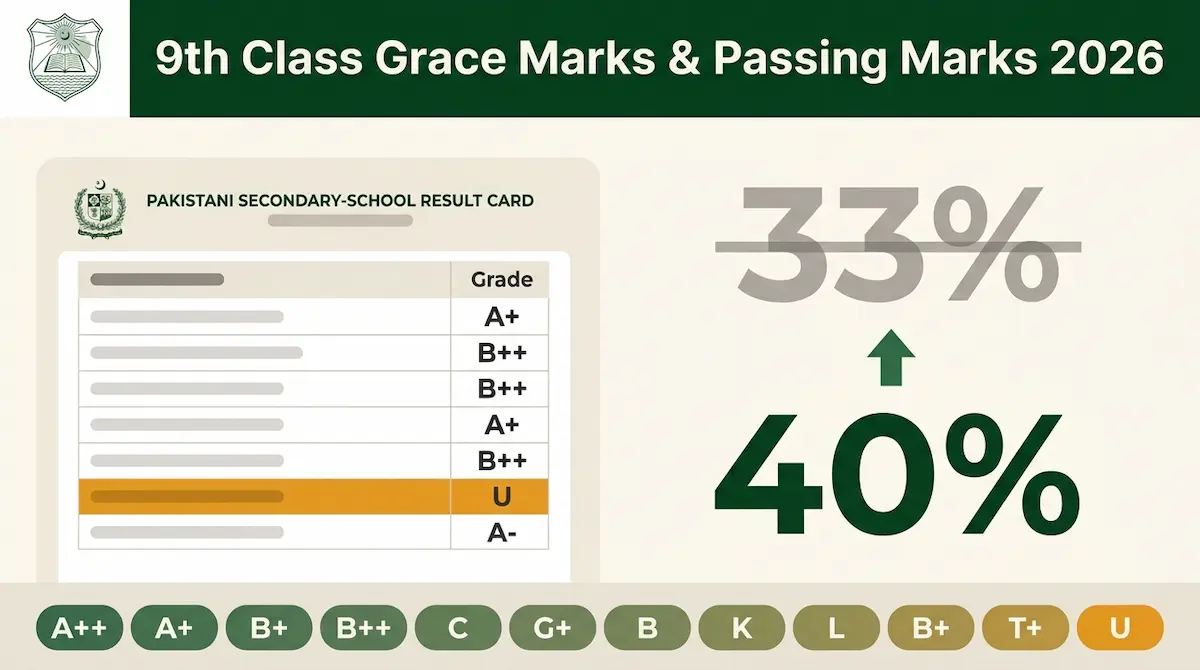
IBCC replaced the old 7-point grading system (A-1, A, B, C, D, E, F) with a 10-point letter scale, and raised the minimum passing mark. The rollout is phased: it applies to 9th and 11th classes from the 2026 annual examinations, and reaches 10th and 12th classes in 2027.
| Item | Previous Rule | Applies From 2026 |
|---|---|---|
| Grading scale | 7-point (A-1 to F) | 10-point (A++ to U) |
| Minimum pass | 33% | 40% |
| GPA / CGPA | Not used | Deferred until further notice |
| First affected classes | — | 9th and 11th (2026) |
Why GPA was held back: the original policy included GPA, but several universities said they were not ready to run admissions on a GPA basis. Education boards agreed to launch the grading reform without it, and IBCC deferred GPA and CGPA until a later notification.
The Official 10-Point Grading Scale
This is the scale your 9th class 2026 result is reported on. The grade is worked out from your percentage in each individual subject.
| Percentage Range | Grade | Description |
|---|---|---|
| 96% – 100% | A++ | Extraordinary |
| 91% – 95% | A+ | Exceptional |
| 86% – 90% | A | Outstanding |
| 81% – 85% | B++ | Excellent |
| 76% – 80% | B+ | Very Good |
| 71% – 75% | B | Good |
| 61% – 70% | C+ | Fairly Good |
| 51% – 60% | C | Above Average |
| 40% – 50% | D | Emerging |
| Below 40% | U | Ungraded — re-appearance required |
9th Class Marks Structure You Are Grading Against
Before you can work out a percentage you need the right denominator. In the Punjab boards, 9th class science subjects carry 60-mark theory papers, because there is no separate practical examination at the end of 9th class — a combined 30-mark practical is held at the end of 10th class instead. That is explained in full on our 9th class practical marks guide.
| Subject | Type | 9th Class Marks |
|---|---|---|
| English | Compulsory | 75 |
| Urdu | Compulsory | 75 |
| Mathematics | Compulsory | 75 |
| Islamiat / Ethics | Compulsory | 50 |
| Pakistan Studies | Compulsory | 50 |
| Physics | Science elective (theory only) | 60 |
| Chemistry | Science elective (theory only) | 60 |
| Biology / Computer Science | Science elective (theory only) | 60 |
| Total | — | 505 |
Your 9th class 505 marks and your 10th class 505 marks combine with the 90 practical marks to form the 1100-mark Matric total on your final SSC certificate.
How to Work Out Your Grade, Step by Step
- Find your percentage in each subject. Divide the marks you obtained by that paper’s total, then multiply by 100. Do this per subject, not on the grand total, because the pass rule applies subject by subject.
Subject % = ( Obtained Marks ÷ Paper Total ) × 100
- Read the grade off the 10-point scale. Match each subject percentage to the table above. A subject below 40% is graded U and goes to the supplementary category, no matter how strong your other subjects are.
- Work out your overall percentage. Add all your obtained marks and divide by 505.
Overall % = ( Total Obtained ÷ 505 ) × 100
- Read your overall grade. Apply the same 10-point table to your overall percentage. This is the grade that appears on your result card — there is no 4.0 figure to calculate for 2026.
Worked Example: Science Group Student
Here is a complete calculation for a Science group candidate, using the correct 60-mark science papers.
| Subject | Paper Total | Obtained | Percentage | Grade |
|---|---|---|---|---|
| English | 75 | 62 | 82.67% | B++ |
| Urdu | 75 | 54 | 72.00% | B |
| Mathematics | 75 | 58 | 77.33% | B+ |
| Islamiat | 50 | 41 | 82.00% | B++ |
| Pakistan Studies | 50 | 36 | 72.00% | B |
| Physics | 60 | 51 | 85.00% | B++ |
| Chemistry | 60 | 48 | 80.00% | B+ |
| Biology | 60 | 52 | 86.67% | A |
| Total | 505 | 402 | 79.60% | B+ |
402 out of 505 works out to 79.60%, which lands in the 76–80% band — Grade B+ (Very Good). Every individual subject is above 40%, so the candidate passes outright with no supplementary papers.
Where GPA 4.0 Fits In Later
IBCC’s original design was to report grade points instead of absolute scores, which is why the reform is described as a 10-point system. When GPA is eventually activated, boards will publish the official grade point attached to each letter grade, and your result card will carry that figure alongside — or instead of — the percentage.
Be careful with unofficial charts. Because IBCC has not released a percentage-to-4.0 mapping for Punjab boards, any site showing one has built it themselves. Using such a chart for a college application or scholarship form can produce a figure that does not match your official record.
Passing Rules for 9th Class 2026
| Rule | What It Means |
|---|---|
| 40% per subject | You need at least 40% in every individual paper. A strong overall percentage does not rescue a subject below 40%. |
| Grade U | Anything under 40% is reported as U (Ungraded) and that paper moves to the supplementary category. |
| Up to two failed subjects | Candidates failing one or two papers stay eligible for the 2nd Annual Examination and continue into 10th class. |
| Practical marks | Not part of your 9th class result. Science practicals are examined once, at the end of 10th class. |
Frequently Asked Questions
Will my 9th class 2026 result show a GPA out of 4.0?
No. IBCC deferred the GPA and CGPA component of the new grading policy until further notice, so your SSC Part-I result reports a letter grade on the 10-point scale instead. Marks and percentages continue to be shown as before.
What is the minimum passing mark for 9th class in 2026?
40% in each individual subject. This replaced the older 33% threshold and applies from the 2026 annual examinations for 9th and 11th classes. Falling below 40% in any single paper places that subject in the supplementary category.
Why did my Physics paper carry 60 marks and not 75?
Because the practical component is separated out. In 9th class you sit a 60-mark theory paper for each science subject, and the 30-mark practical for that subject is examined at the end of 10th class covering both years’ experiments.
How do I convert my percentage into the new letter grade?
Work out the percentage for each subject separately, then match it against the 10-point table on this page. For your overall grade, divide your total obtained marks by 505 and apply the same table to that percentage.
Does the new 10-point scale apply to 10th class as well?
Not yet. The rollout is phased: 9th and 11th classes moved to the new scale in 2026, and 10th and 12th classes follow in 2027. Until then, 10th class results continue on the previous system.
Where can I check my 9th class result and grade?
You can look up your marks by roll number, search the gazette by name, or use your board’s SMS shortcode. All nine Punjab boards and their result pages are listed on our all boards directory.