
9th Class Science vs Arts Group Pass Rate Trends (Punjab 2025)
Across Punjab’s 2025 SSC Part-I results, the Science group passed at a higher rate than the Humanities group in six of the seven boards that published group-wise figures. The gap ran from 2.07 percentage points in Bahawalpur to 18.71 in Rawalpindi. Gujranwala reversed it: its General group passed at 52.81% against Science at 46.24%.
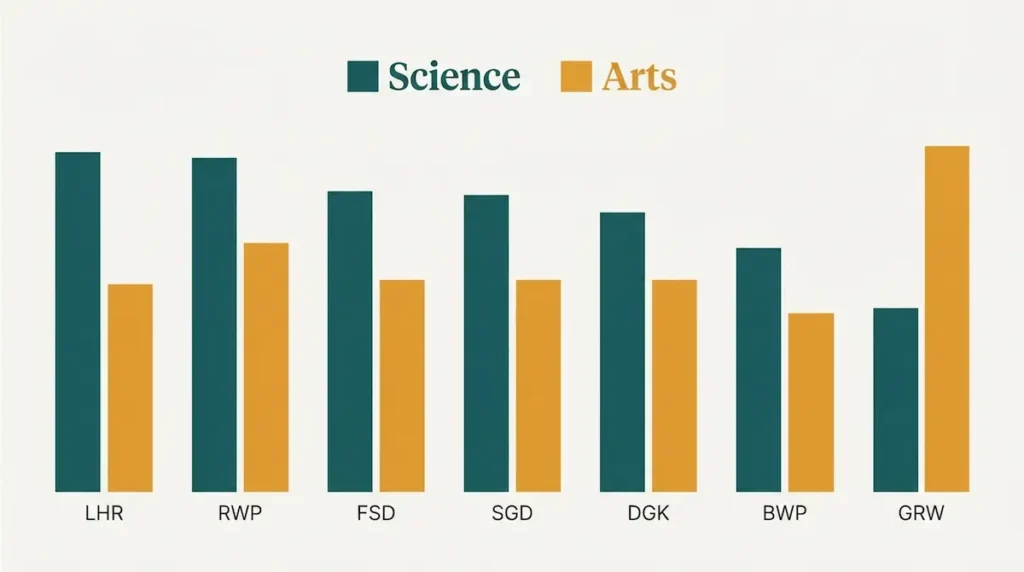
Board-by-board, 2025
| Board | Science pass % | Arts / Humanities pass % | Difference |
|---|---|---|---|
| Rawalpindi | 49.01 | 30.30 | +18.71 |
| Faisalabad | 51.80 | 41.10 | +10.70 |
| Lahore | 47.47 | 37.37 | +10.10 |
| Sargodha | 47.17 | 42.39 | +4.78 |
| DG Khan | 60.05 | 57.37 | +2.68 |
| Bahawalpur | 43.31 | 41.24 | +2.07 |
| Gujranwala | 46.24 | 52.81 | −6.57 |
Which board you sit under matters more than which group you pick
Science pass rates alone ranged from 43.31% in Bahawalpur to 60.05% in DG Khan — a spread of 16.74 points. That spread is wider than the science–arts gap in six of the seven boards. A Science student in Bahawalpur faced worse odds than an Arts student in DG Khan by more than fourteen points.
So the stream you choose is a smaller variable than most result-day commentary assumes.
Why Gujranwala went the other way
Gujranwala entered 129,439 candidates in its General group against 70,864 in Science. The arts stream there was the majority choice, not the leftover one. A stream that holds two-thirds of a cohort carries the full ability range, and its pass rate lands near the board average.
Rawalpindi is the mirror image: 52,219 in Humanities against 199,176 in Science. Where arts is a minority stream, it tends to absorb students moved out of Science after weak middle-school performance — and the rate falls away from the board average. That is a composition effect, not a difficulty effect.
The private candidate channel
Two distinct things get confused in most result coverage. Private institutes are fee-paying schools. Private candidates register directly with the board without attending an institution at all.
The second group is where arts numbers collapse. In Rawalpindi, 76,691 private candidates appeared and 22,237 passed — 29.00%. In Lahore, 116,226 private candidates appeared and only 38,806 passed, a 33.39% rate. Males in the humanities group were the weakest subgroup in Rawalpindi at 20.19%, and in Lahore at 21.07%.
Private candidates cluster heavily in Arts. Where they make up a large share of arts entries, they pull the published stream figure down — and that figure then gets quoted as though it describes classroom students.
2025 figures do not forecast 2026
Two changes break the comparison.
The 2025 papers were marked against a 33% per-subject minimum. From the 2026 first annual examination the minimum is 40% in every paper. A candidate scoring 36% in one subject passed last year and does not this year. Because arts entries sit closer to that boundary in most boards, the same rule removes proportionally more of them — expect the gap to widen where it already exists, and to narrow the Gujranwala reversal. If you want to see where your own marks land, the letter grade each percentage converts into shows the boundaries.
The second change is enforcement. Punjab Education Minister Rana Sikandar Hayat said the 2025 figures reflected students’ real performance following the crackdown on organised cheating networks across Punjab boards, and that while the numbers looked disappointing they indicated a more transparent examination process. Both changes push the same direction.
Reading your own board’s number
Treat the group figure as a description of who sat the paper, not of how hard it was. Before drawing conclusions, check three things in your board’s gazette: how many candidates each stream actually entered, what share were private candidates, and how far each stream’s rate sits from the board’s overall figure. In DG Khan the humanities rate landed within 0.03 points of the board average. In Rawalpindi it landed 14.82 points below it. Same country, same syllabus, same week.
FAQ
Which group had the higher pass rate in Punjab in 2025?
Science, in six of seven boards with published splits. Gujranwala was the exception, where the General group led by 6.57 points.
Is the arts group easier to pass?
The 2025 data does not support that. Where arts is the majority stream, it matched or beat Science. Where it is a minority stream with heavy private-candidate entry, it fell behind.
Will 2026 pass rates be lower?
The per-subject minimum rose from 33% to 40%. Applied to the 2025 mark distribution, that alone removes a band of candidates who previously cleared.

science sahi ya art, meri to science he
Depend on your interest!